 Français
  English
  Deutsch
  Español
  Italiano

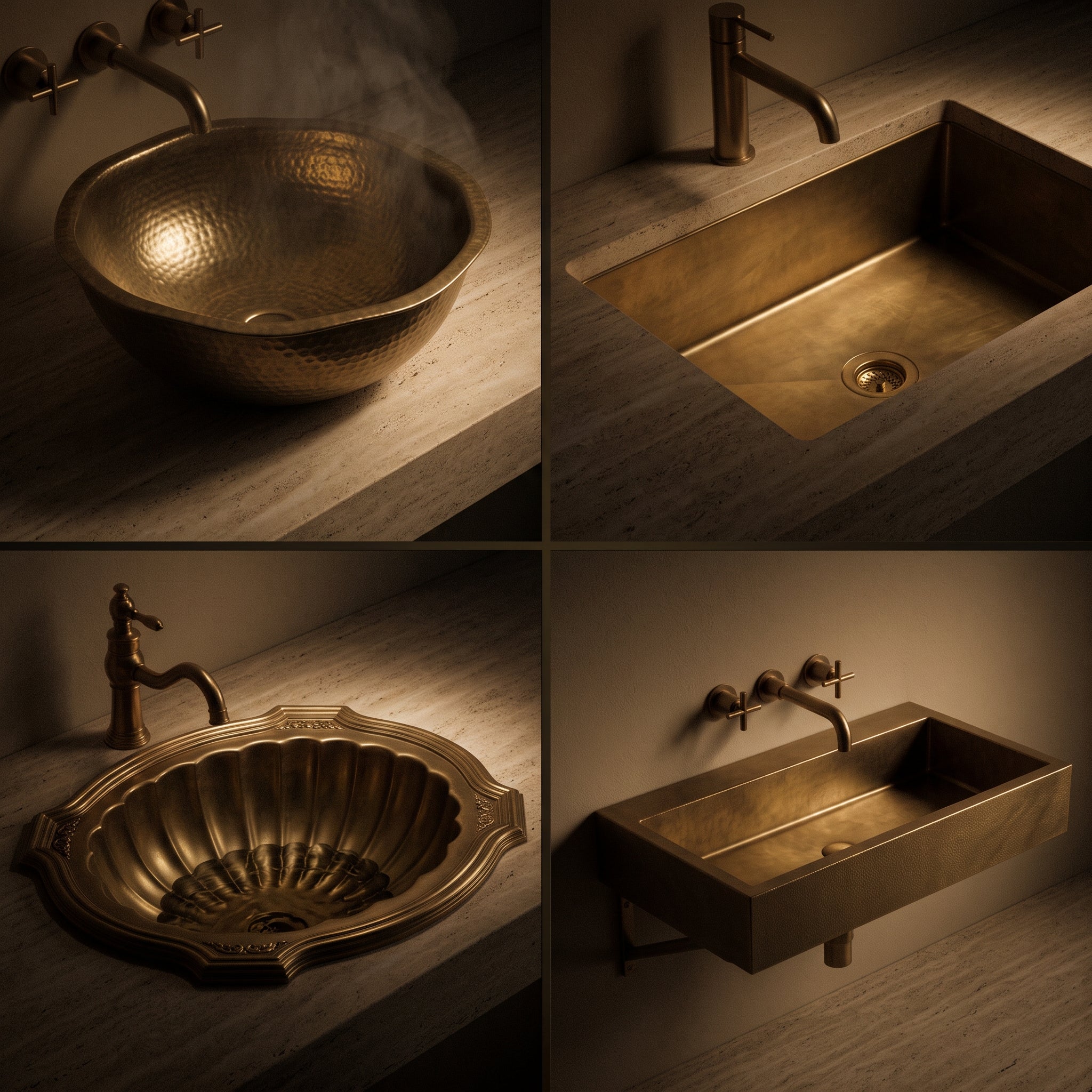

Vessel, undermount, drop-in, or wall-mount, the right type depends on the bathroom, not just the look.
The four main bathroom sink types are vessel (a bowl sitting on top of the counter), undermount (mounted beneath the counter for a seamless surface), drop-in (set into a cutout with a visible rim), and wall-mount (attached directly to the wall, no counter needed). Vitreous china is the most affordable material, stainless steel the most chip-resistant, and solid brass or copper the most durable long-term since they age into character rather than showing wear.
Most bathroom sink decisions get made on looks alone, and then run into a layout or maintenance problem a few years later. The type of sink, not just its shape or finish, determines how it’s cleaned, how much counter space it needs, whether it can go in a small powder room, and how it holds up over a decade of daily use.
This guide covers the four sink types Insideast makes, in vessel, undermount, and drop-in styles, plus wall-mount as an option worth knowing even where a matching basin isn’t part of the range, how the common sink materials compare, which type fits a small bathroom best, and a pros and cons table to weigh them side by side.
- Vessel sinks sit on top of the counter and are the easiest to install, no cutout needed, just a drain hole.
- Undermount sinks give the cleanest look and easiest cleanup but need clips or epoxy to hold them from below.
- Drop-in sinks are the fastest and least expensive to install, with a visible rim as the tradeoff.
- Wall-mount sinks save the most floor space and suit small bathrooms, though a basin needs pairing with a wall-mount faucet and exposed or in-wall plumbing.
- Solid brass and copper are the only common sink materials that improve with age rather than wearing down.
Vessel sinks
A vessel sink is a standalone bowl that sits entirely above the countertop rather than being recessed into it. It’s the most sculptural of the four types, the bowl itself is the visual centerpiece of the vanity, and it’s also the simplest to install, since it doesn’t need a precisely cut counter opening at all, just a drain hole and a bead of silicone underneath.

Vessel Sink
Sits on top, easiest install
Insideast’s hammered brass countertop washbasin needs only a 1.65 inch drain hole and silicone sealant, no cutout or undermount fitting required. Because the bowl height adds several inches above the counter, vessel sinks typically pair with a tall or wall-mounted faucet and a slightly lower vanity height than a standard undermount setup.
The tradeoff is more exposed surface area to clean, since the bowl’s exterior collects dust and water spots the way a standard recessed sink doesn’t. Most vessel sinks also skip a built-in overflow drain, since the bowl itself is the standalone fixture rather than a recess in a larger basin, worth knowing if an overflow safeguard matters for how the sink gets used. Vessel sinks work particularly well with unlacquered brass and copper, materials that develop patina with exposure, since the entire bowl exterior is on display rather than hidden below a counter edge. The full range is on the brass vessel sinks collection.
Undermount sinks
An undermount sink mounts beneath the countertop so no rim sits on top, which means the counter surface reads as one continuous piece and crumbs or water can be wiped straight into the bowl without catching on a lip. It’s the most seamless-looking option and the easiest to keep clean day to day.

Undermount Sink
Seamless surface, hidden hardware
The round hammered brass undermount sink is built for exactly this installation, hand-hammered solid brass with a clean rim designed to sit flush beneath a vanity counter. Because the sink hangs entirely from clips and adhesive rather than resting its weight on the counter, the countertop material and the installation hardware both matter more here than with a drop-in.
Undermount only works with a solid, rigid countertop, stone, quartz, or a sealed hardwood, since laminate and thin composite tops generally don’t hold the mounting hardware reliably. For the full mechanics of how it’s held in place, the guide on undermount sink clips covers clip spacing, countertop material differences, and installation step by step. For how undermount compares directly to drop-in on cost and maintenance, see undermount vs drop-in brass sinks.
Drop-in sinks
A drop-in sink, sometimes called a self-rimming or top-mount sink, rests into a cutout with its rim resting on top of the countertop. The weight of the sink itself, plus the rim, is what holds it in place, which makes it the fastest and least expensive of the four types to install, and the easiest for a straightforward retrofit onto an existing counter.

Drop-In Sink
Rim on top, faster install
The antique oval brass sink shows the style clearly, its decorative scalloped flange rests visibly on the counter, becoming part of the design rather than something to hide. That visible rim is also the main maintenance tradeoff, it creates a seam where water and debris can collect, so it needs periodic wiping that an undermount sink doesn’t.
Drop-in is the more forgiving choice for anyone replacing an existing sink without wanting to modify the counter cutout, since drop-in cutouts are typically simpler and more standardized than the precision opening an undermount sink needs. The broader range of undermount and drop-in styles is on the undermount and drop-in brass sinks collection.

Handcrafted, Not Molded
A decagon hammered brass drop-in
Each facet and the hand-hammered texture are marks of the Marrakech workshop, not a mold.
Wall-mount and pedestal sinks
A wall-mount sink attaches directly to the wall with brackets, no vanity, cabinet, or countertop involved at all. It’s the type most associated with small powder rooms and period-style bathrooms, since it frees up visible floor space and keeps the plumbing exposed as part of the design rather than hidden.

How the four mounting styles compare in cross-section. Wall-mount needs no counter or cabinet at all.
Insideast doesn’t currently make the wall-mount basin itself, the sinks in the range are vessel, undermount, and drop-in. What the collection does include is the hardware that goes with a wall-mount setup: the solid brass wall-mount faucet collection, which pairs naturally with a wall-mount basin from another source, or works just as well mounted above a vessel or undermount sink for the same clean, minimal look without giving up counter space entirely. For a bathroom where a wall-mount basin isn’t practical but floor space is still tight, a compact vessel sink on a narrow vanity is the closer alternative from the range.
A note on pedestal sinks: pedestal sinks, a basin mounted on a slender floor-standing column rather than a wall bracket, solve the same small-bathroom space problem as wall-mount and are worth knowing as the other classic option, especially for a traditional or period-style powder room. Like wall-mount, a pedestal sink gives up all storage underneath and isn’t part of the Insideast range, but the same logic applies: a compact vessel sink on a narrow vanity keeps some of that under-sink storage while still working in a tight footprint.
Materials compared: brass vs copper vs ceramic vs stainless vs stone
The mounting style determines how a sink installs; the material determines how it looks and holds up over the years that follow. The five most common bathroom sink materials handle wear, cost, and appearance very differently.

Brass

Copper

Ceramic

Stainless

Stone
| Material | Durability | Maintenance | Typical cost |
|---|---|---|---|
| Vitreous china / ceramic | Hard, glass-like glaze; can chip or crack on impact | Non-porous, easy to clean; avoid harsh scouring | Most affordable |
| Stainless steel | Resists chipping and cracking best; thinner gauges dent more easily | Wipes clean; can show water spots on lower grades | Mid-range |
| Natural stone (marble, granite) | Durable but can scratch or etch; porous stones need sealing | Periodic resealing; avoid acidic cleaners | Higher, varies by stone |
| Solid brass | Very durable; thick gauge resists dents; develops a warm patina rather than wearing | Wipe clean; no coating to chip or peel | Higher, handmade |
| Solid copper | Very durable; naturally antimicrobial; patinas faster and deeper than brass | Wipe clean; patina is the finish, not a defect | Higher, handmade |
A Note on Vitreous China
Ceramic and vitreous china bathroom fixtures sold in the US and Canada are generally built to ASME A112.19.2, the harmonized standard covering material, dimensional, and performance requirements for ceramic plumbing fixtures. It’s a useful baseline for comparing quality across brands, since not every ceramic sink sold is necessarily made to the full standard.
Solid brass and copper sit apart from the other three in one specific way: they’re the only materials on this list designed to change in appearance over time rather than resist change. A ceramic or stainless sink looks its best on day one and gradually shows wear from there. Brass and copper start bright and polished, then develop a living patina, a warmer, deeper tone that most people consider more attractive with age, not less. Copper tends to patina faster and more dramatically than brass, moving through amber and brown tones sooner. That’s a genuinely different maintenance philosophy from the other three materials, worth factoring in alongside cost and durability.
Pros and cons table
| Type | Pros | Cons |
|---|---|---|
| Vessel | Simple install, no cutout needed; strong visual statement | More exposed surface to clean; needs a taller or wall-mount faucet |
| Undermount | Seamless look; easiest everyday cleanup | Needs a solid countertop and clip/epoxy installation; harder retrofit |
| Drop-in | Fastest, least expensive install; simple retrofit | Visible rim collects debris and water over time |
| Wall-mount | Saves the most floor space; suits small or period bathrooms | No counter or storage beneath; needs exposed or in-wall plumbing |
| Pedestal | Classic look; frees floor space like wall-mount | No storage; less stable than a wall- or counter-mounted sink |
Beyond the tradeoffs in the table, it’s worth matching the type to how the bathroom actually gets used, not just how it looks. A vessel sink’s exposed bowl and splash pattern can become a daily annoyance in a high-traffic family or kids’ bathroom, even though it photographs beautifully. A wall-mount or pedestal sink’s missing storage is a bigger problem in a primary bathroom that needs to hold everyday toiletries than in a guest powder room that doesn’t. The type that wins on style isn’t always the type that holds up best against how a specific bathroom gets used every day.
Best for small bathrooms
Wall-mount and pedestal sinks are generally the strongest choices for a genuinely small bathroom or powder room, since removing the vanity and counter entirely opens up floor space that a room of that size can’t spare. Where storage underneath still matters, a compact vessel sink on a narrow console or a smaller drop-in on a shallow vanity are the next best options, both take up less footprint than a full undermount installation with a wide counter.


@jacumbahotspringshotel: “Our guest rooms are now open for bookings here at Jacumba Hot Springs Hotel.” A compact guest bathroom setup, faucet, sink, and p-trap, in the kind of small footprint many home bathrooms are working with too. View post
Light also plays a bigger role than most people expect in a small bathroom. A vessel or drop-in sink in a lighter material, ceramic, stainless, or a brighter stone, reflects more light in a room with limited natural light than a dark stone or heavily patinated finish would, which is worth weighing alongside the mounting style itself.
Frequently Asked Questions
What are the different types of bathroom sinks?
The main types are vessel sinks, which sit on top of the counter as a standalone bowl; undermount sinks, mounted beneath the counter for a seamless look; drop-in sinks, which rest into a cutout with a visible rim on top; and wall-mount sinks, which attach directly to the wall with no counter or cabinet needed at all. Each suits a different bathroom layout, budget, and maintenance preference.
What type of bathroom sink is best for a small bathroom?
Wall-mount and pedestal sinks are usually the best choices for a small bathroom, since neither needs a cabinet or counter, which frees up visible floor space and makes the room read larger. A compact vessel or drop-in sink on a narrow vanity is the next best option when some storage underneath is still needed.
What’s the best material for a bathroom sink?
There’s no single best material, it depends on priorities. Vitreous china and ceramic are the most affordable and easiest to find in standard sizes. Stainless steel resists chipping and cracking best. Natural stone gives a one-of-a-kind look but needs periodic sealing. Solid brass and copper are the most durable long-term and the only materials that improve in appearance with age rather than showing wear.
What’s the difference between an undermount and a drop-in bathroom sink?
An undermount sink mounts beneath the countertop with no rim on top, so the counter surface reads as one continuous piece and water wipes directly into the bowl. A drop-in sink rests into a cutout with its rim resting on top of the counter, which is a faster, less expensive installation but leaves a visible seam where debris and water can collect.
Are brass bathroom sinks a good choice?
Solid unlacquered brass is a strong choice for anyone who wants a fixture that ages into character rather than looking worn. It resists corrosion, has natural antimicrobial properties, and develops a living patina over years of use instead of showing scratches or dullness the way stainless steel can. The tradeoff is weight and price, both higher than ceramic or stainless of the same size.
Choosing a sink type is the first decision, the material and finish are the ones that shape how it looks a decade from now. Browse the full Insideast bathroom sink range, vessel, undermount, and drop-in, handmade in solid brass and copper in Marrakech.